

Flashspoter - The latest news from the world of mini computing comes back from the Raspberry Pi. The company has officially adjusted the prices of its single-board computer products due to the surge in memory costs that is now happening globally. The increase is effective immediately and impacts several major models, in particular Raspberry Pi 4, Raspberry Pi 5, as well as Compute Module 5.
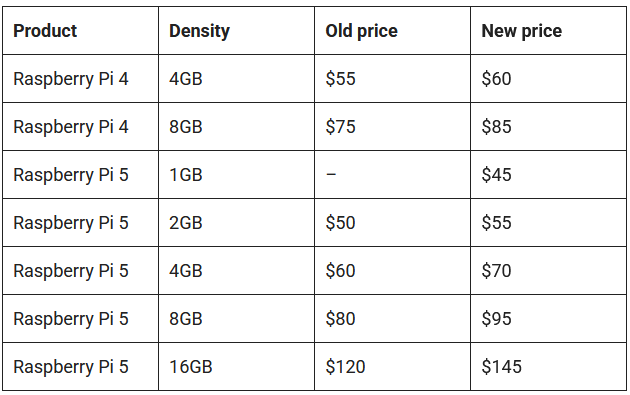
The raise in price is different for each series and the RAM capacity of the device. The Raspberry Pi 4 and Raspberry Pi 5 went up by an amount somewhere between $5 and $25. On the other hand, the Compute Module 5 16GB version has gone up in price by $20 and its price is now starting from $140. This price adjustment is essentially a step responsive to rising production costs, particularly with regard to memory.
The increase in the price of RAM in recent months has indeed become a global phenomenon. The main cause is the massive demand from the AI industry that is growing so fast. Infrastructures for AI, which include data centers and devices with large models, are in need of very large amounts of RAM. The two industries, that is, consumer-grade computing and small device manufacturers like the Raspberry Pi, are likewise impacted because the capacity for memory production cannot catch up with the demand.
Although the prices are being altered, the Raspberry Pi remains a good piece of news for people who are in need of more affordable substitutes. A $45 single-board computer with 1GB of RAM is a new variant of the Raspberry Pi 5 that the company just announced. Still, this variant features all the main specs of the 5 model, such as a 2.4 GHz Arm Cortex-A76 quad-core processor, dual-band Wi-Fi connectivity, and PCI Express support. The existence of the lowest model can be a great user who doesn't need a big memory for simple projects or study experiments.
The phenomenon of rising memory prices has not only afflicted the Raspberry Pi. Several other hardware industry players such as CyberPowerPC and Maingear have announced that their businesses have also been affected. The surge in prices made some computer stores sell RAM at prices following daily market conditions, a situation that had also occurred on GPUs some time ago. After GPU prices began to stabilize throughout the year, now the pressure is moving to the memory sector and supporting chips.
Although many fear that hardware prices will continue to climb without returning to normal, Raspberry Pi states that this price adjustment is temporary. The company plans to lower prices again after global memory supply conditions improve and extreme demand from the AI sector subsides. Of course, whether prices will really fall still depends on the dynamics of the technology market of the next few months. But the statement shows that the Raspberry Pi has maintained its commitment to providing affordable computing for the developer, educator, and hobbyist community.
Artificial intelligence in the present day is still a major consumer of RAM and GPUs with the trend being a large volume of memory not only for model training but also for daily inference in the data center. This increase in demand has hardware manufacturers rethinking their business strategies to keep products available. Raspberry Pi has become one of the most talked-about examples whose devices are popularly known as cheap solutions for light computing, DIY projects, robotics, and embedded systems.
Users now have the freedom to choose the option that meets their requirements and financial plan following the launch of the new Raspberry Pi 5 1GB variant and the company's openness about the reasons for the price changes. The presence of cheaper models still contributes to the Raspberry Pi's status as a multi-purpose platform with a price range that is still attractive to the consumer, albeit there has been a rise in some lines.
Post a Comment